https://www.google.com/travel/flights
| Coastal Loop East > | South West Loop | Offbeat China | Shanghai to Shenzhen | Yunnan to Shenzhen |
| Xishuangbanna to Shenzhen | china south west | Chongqing to Guangzhou | Guizhou | Kunming Xishuangbanna |
An train journey from Shanghai to Shenzhen offers an incredible opportunity to explore China beyond the major metropolises. Instead of taking the direct coastal route, the ultimate path for spectacular landscapes and deeply rooted traditional culture takes an inland trajectory via Anhui and Jiangxi provinces, before tracking down to the historic region of Fujian and Chaoshan.
Here is a beautifully paced 18-day itinerary that combines misty mountains, ancient villages, historic tea culture, and coastal traditions.
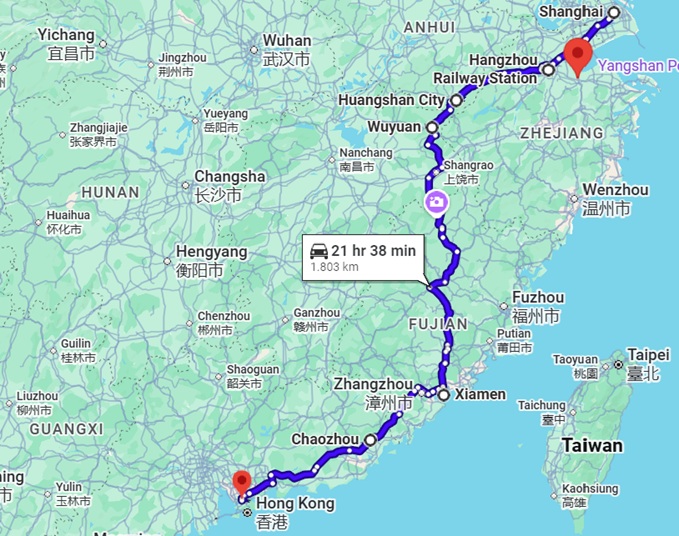
https://maps.app.goo.gl/srrUihJzognm7eKZA
Days 1–3: Shanghai to Hangzhou
Days 4–6: Hangzhou to Huangshan (Yellow Mountain)
Days 7–9: Huangshan to Wuyuan
Days 10–13: Wuyuan to Xiamen
Days 14–16: Xiamen to Chaoshan (Chaozhou/Shantou)
Days 17–18: Chaoshan to Shenzhen
Your journey begins at the massive , where you will catch a short 1-hour high-speed train to Hangzhou. Hangzhou is famous for its timeless, poetic beauty.
-
Landscape & Scenery: Spend your time around West Lake, admiring the willow-lined causeways, mist-covered hills, and traditional pagodas that have inspired Chinese painters for centuries.
-
Culture & Tradition: Visit the Meijiawu Tea Village to learn about the traditional cultivation of Dragon Well (Longjing) green tea, and wander through Hefang Street to see ancient pharmacies and traditional paper-cutting craftsmen.
Days 4–6: Hangzhou to Huangshan (Yellow Mountain)
Board a bullet train from Hangzhou East Railway Station East Square heading west to Huangshanbei North Railway Station (approx. 1.5 hours).
-
Landscape & Scenery: Huangshan is globally renowned for its jagged granite peaks, twisted ancient pine trees, and the surreal “Sea of Clouds.” Spend two days hiking or taking cable cars up the peaks, staying overnight on the mountain to catch the spectacular sunrise.
-
Culture & Tradition: At the base of the mountain, explore the UNESCO-listed ancient villages of Xidi and Hongcun. These villages feature extraordinarily well-preserved Huizhou-style architecture, characterized by white walls, black tiled roofs, and advanced ancient water canal systems.
Days 7–9: Huangshan to Wuyuan
Take a quick 20-minute bullet train south to Wuyuan County. Wuyuan is widely celebrated as having some of the most beautiful rural countryside in China.
-
Landscape & Scenery: The region is famous for its terraced green hills, trickling streams, and vibrant agricultural valleys. (If traveling in spring, the fields burst into a brilliant blanket of yellow rapeseed flowers).
-
Culture & Tradition: Wander through tiny, quiet villages like Likeng and Wangkou. You can walk across ancient covered bridges, explore ancestral halls, and witness traditional rural life that remains largely unchanged by modern technology.
Likeng Yuelai Inn
Beside Xiaoqiao Liushui, Likeng Scenic Area, Wuyuan, Jiangxi, 333212, China
Days 10–13: Wuyuan to Xiamen
Catch a bullet train connecting down through Fujian province to the coastal city of Xiamen (approx. 4.5 hours). This brings you into the vibrant Minnan cultural sphere.
-
Landscape & Scenery: Xiamen is a breezy, subtropical island city. Spend a day on Gulangyu Island, a pedestrian-only enclave famed for its colonial-era architecture, lush banyan trees, and coastal views.
-
Culture & Tradition: Take a day trip from Xiamen out into the mountainous countryside of Nanjing County to see the Fujian Tulou. These are massive, circular earthen fortress-houses built by the Hakka people centuries ago to defend against bandits. Walking inside these living communities offers an incredible glimpse into traditional communal culture.
Days 14–16: Xiamen to Chaoshan (Chaozhou/Shantou)
Hop back on the coastal rail line for a short 1.5-hour trip south into the Chaoshan region of Guangdong province. Chaozhou is a cultural goldmine that many international tourists overlook.
-
Landscape & Scenery: Stroll across the ancient Guangji Bridge, a unique historical drawbridge made of floating wooden boats connected across the Han River.
-
Culture & Tradition: Chaoshan is the birthplace of Gongfu Tea culture; you can experience formal, meticulous tea ceremonies in old courtyard tea houses. The region is also globally famed for its culinary arts—be sure to try authentic Chaoshan beef hotpot, hand-pulled beef balls, and marinated goose.
Days 17–18: Chaoshan to Shenzhen
Conclude your epic journey with a final 2-hour train ride into Shenzhen.
-
The Transition: After 15 days of ancient villages, misty mountains, and centuries-old traditions, arriving in Shenzhen offers a striking contrast. Spend your final days exploring the ultra-modern architecture, lush city parks, and tech hubs of China’s Silicon Valley before your departure.
Would you like more details on booking multi-city train tickets in China, or specific recommendations on where to stay near the mountain paths?
The Grand East-to-South Route
| Segment | Highlights | Recommended Duration |
| Shanghai (Start) | The Bund, Yu Garden, world-class dining, and modern skyscrapers. | 3 Days |
| Suzhou & Hangzhou | Classical Chinese gardens in Suzhou; the serene West Lake in Hangzhou. | 3 Days |
| Huangshan (Yellow Mountain) | Dramatic granite peaks, pine trees, and hot springs. | 3 Days |
| Wuyishan | UNESCO site known for its tea plantations, rafting, and hiking. | 3 Days |
| Xiamen & Quanzhou | Coastal vibes, Gulangyu Island, and rich maritime history. | 3 Days |
| Shenzhen (End) | Futian CBD, Window of the World, and modern tech hubs. | 3 Days |
Detailed Itinerary Breakdown
Days 1–3: Shanghai – The Modern Gateway
Start your journey in China’s most cosmopolitan city. Spend your time walking along the historic Bund, exploring the traditional lanes of the French Concession, and visiting the Shanghai Museum.
-
Cultural Sight: Take a evening cruise on the Huangpu River to see the contrasting skylines of Pudong and Puxi.
Days 4–6: The Jiangnan Region (Suzhou & Hangzhou)
Take a short 30-minute high-speed train to Suzhou, famous for its classical gardens (like the Humble Administrator’s Garden) and ancient canals. Continue to Hangzhou (about 1.5 hours by train), home to the legendary West Lake. Rent a bicycle to ride around the lake or visit a traditional tea house in the Longjing tea fields.
Days 7–9: Huangshan – Peaks into the Clouds
Travel inland to the city of Huangshan. Spend two days exploring the Yellow Mountain (Huangshan) National Park. You can stay overnight on the mountain to catch an unforgettable sunrise. On your third day, visit the ancient villages of Xidi and Hongcun, which feature remarkably preserved traditional Hui-style architecture.
Days 10–12: Wuyishan – Tea and Nature
Head south to Mount Wuyi (Wuyishan). This area is famous for its dramatic red sandstone cliffs and the Nine-Bend Stream. Take a traditional bamboo raft down the river, hike up to the Heavenly Pitch, and sample authentic Da Hong Pao oolong tea right at the source.
Days 13–15: Xiamen & Quanzhou – Maritime Heritage
Continue south to the coast. Xiamen offers a relaxed island atmosphere—spend a day on Gulangyu Island, known for its colonial architecture and pedestrian-only streets. A short train ride away is Quanzhou, a historic maritime hub that served as the starting point of the historic Maritime Silk Road, featuring stunning ancient mosques and temples.
Days 16–18: Shenzhen – The Tech Frontier
Conclude your trip in Shenzhen. Witness the breakneck pace of China’s “Silicon Valley.” Visit the Shenzhen Museum to learn how the city transformed from a fishing village into a global tech powerhouse in just four decades. Relax at the OCT Loft creative park or enjoy the coastline at Dameisha.